
Lincoln Park
939 W North Ave, Suite 890
Chicago, IL 60642
Restorative
A dental crown is a custom cap that covers the visible part of a tooth above the gum line. Crowns rebuild teeth that are cracked, heavily filled, weakened after root canal therapy, or worn, and they complete single-tooth implants when connected to an abutment.
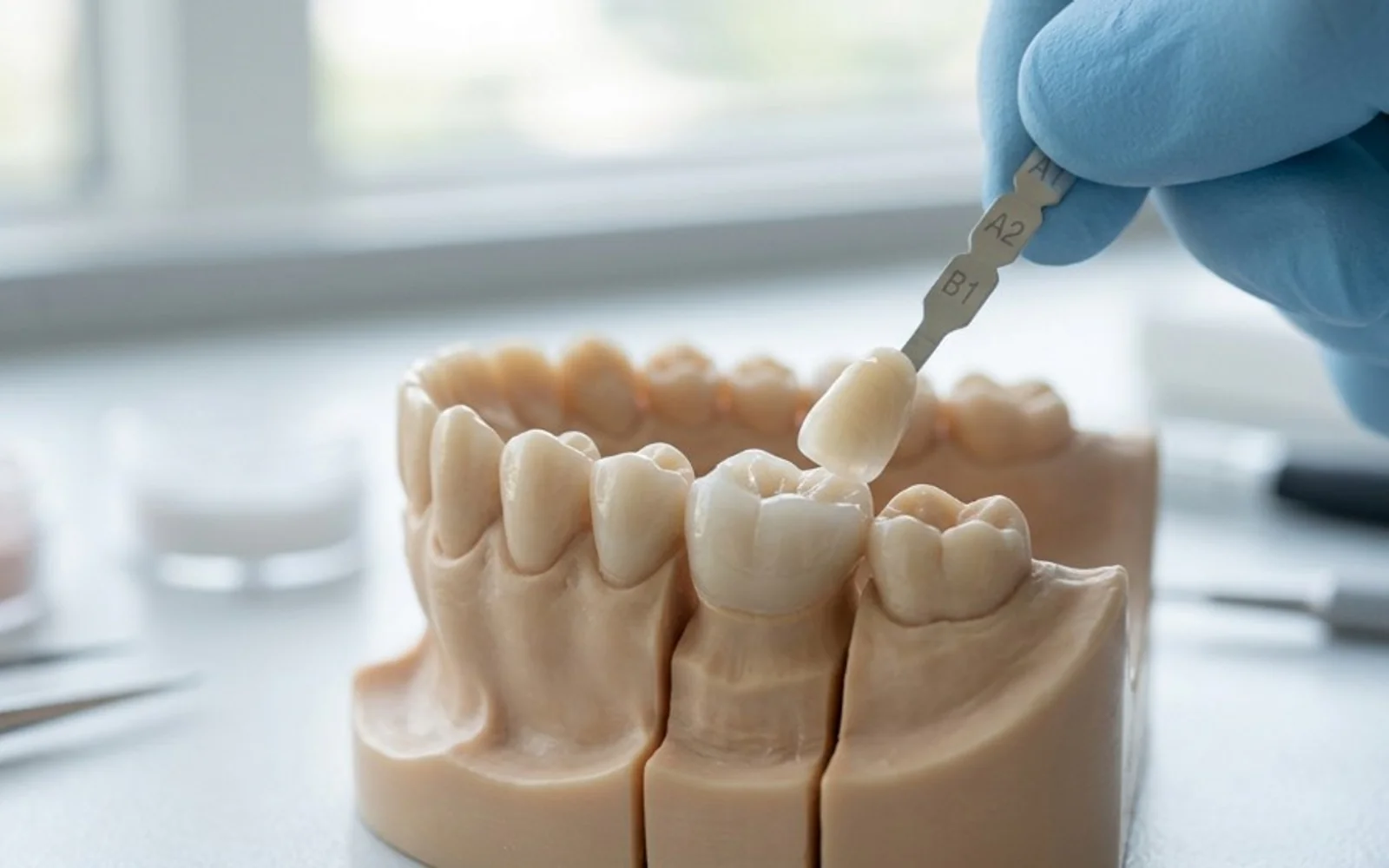
A dental crown is what you reach for when there is no longer enough sound tooth to hold a filling. Every filling leans on the walls around it, and once those walls are thin, cracked, or mostly old filling themselves, another filling only moves the problem a year down the road. A crown covers the tooth rather than filling a hole in it, so biting force spreads across the whole tooth instead of levering the remaining walls apart. The honest counterpoint is that fitting one removes more tooth, which is why an onlay is sometimes the better answer and why we say so when it is.
Material follows the position of the tooth and your bite rather than preference. Layered porcelain looks best and belongs where the tooth shows when you smile. Zirconia is considerably stronger and is the usual choice further back, or for anyone who grinds. Gold remains the most forgiving option for a molar under heavy load and asks the least of the tooth beneath it. If you grind, the material conversation and the night guard conversation happen together, because grinding is what breaks crowns.
Most crowns take two visits. The first is preparation under local anesthetic, a digital scan, and a temporary crown to wear while the lab makes the real one. The second is the fit, where the bite is checked and adjusted before anything is cemented, because a crown sitting even slightly high will stay sore and will not settle on its own. Ten to fifteen years is a fair expectation and often longer. The two usual reasons for early failure are decay starting at the margin and grinding, and both are things you can act on.
Available at both offices. Pick the one that's closer to you.
Lincoln Park
939 W North Ave, Suite 890
Chicago, IL 60642
Schaumburg
501 W Golf Rd, Ste B
Schaumburg, IL 60195