
Skip to content
Dental Salon

Specialty

Root canal therapy

Endodontics focuses on saving natural teeth by treating the pulp and tissues within, and root canal therapy succeeds in saving the tooth about 95% of the time. This specialized care removes infected or inflamed pulp, preserving the tooth from extraction.
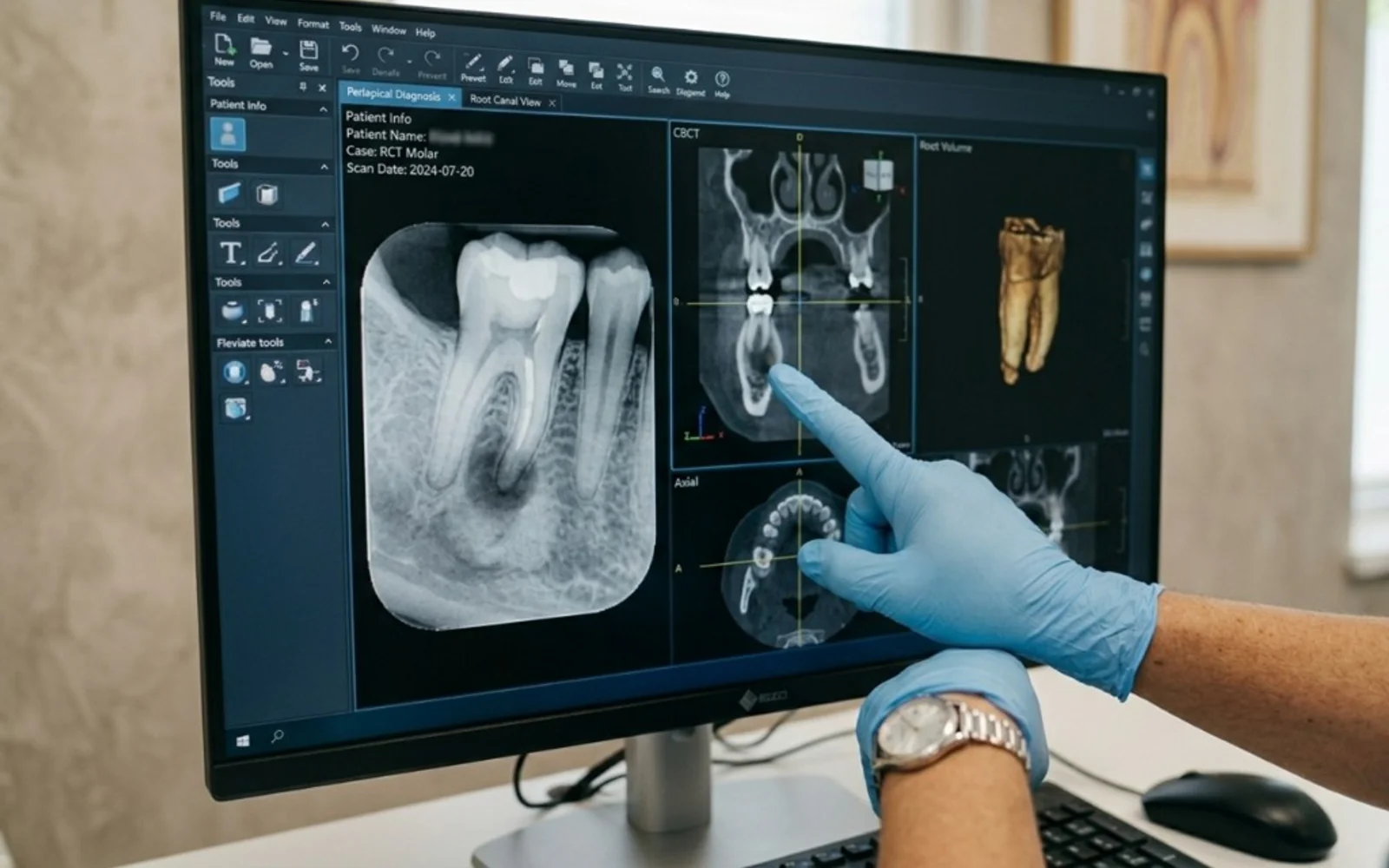
A clinician reviewing root canal imaging and CBCT scans on a monitor at Dental Salon.

Root canal therapy often carries an undeserved reputation. However, with modern imaging, advanced anesthetic techniques, and a dentist focused on the procedure, most patients describe the visit as comparable to a routine filling, walking out with a natural tooth saved instead of extracted.

Our endodontic care at Dental Salon is provided by a dentist whose practice is focused on endodontics, with extensive experience, having performed over 2,000 root canal treatments. This includes retreatments and complex cases requiring careful diagnostic work, often utilizing cone-beam (CBCT) imaging to enhance diagnostic precision. This dentist collaborates closely with our general dentists who plan and place the final crown, ensuring a durable long-term result.

Endodontic visits are exclusively available at our Lincoln Park, Chicago office. For our Schaumburg patients, we coordinate a seamless one-time visit to Lincoln Park for the root canal, after which you can return to Schaumburg for your final crown. Our shared records and integrated team ensure no outside referral is needed.

Who it's a good fit for

  • You have severe or lingering tooth pain, especially with hot, cold, or pressure
  • Your dentist recommended a root canal and you want a clinician focused on endodontics
  • You had a root canal before that didn't fully heal and may need retreatment
  • You'd rather save the tooth than have it extracted if that's still possible
  • You have deep decay, a crack, or trauma that reached the nerve

What to expect

  1. Diagnostic visit: exam, x-rays, and 3D scan when imaging changes the plan
  2. Written plan: root canal vs extraction vs watch-and-wait, with costs
  3. Treatment: usually one visit, sometimes two for complex or retreatment cases
  4. Crown visit with your general dentist to protect the treated tooth
  5. Healing check at 6–12 months to confirm bone recovery

Common questions

Will the root canal hurt?
The procedure itself is done under local anesthetic and is comparable to a routine filling for most patients. The pain you might be feeling beforehand, from the inflamed or infected pulp, is what the root canal relieves. Soreness for a day or two after is normal.
Is a root canal better than just pulling the tooth?
Almost always, yes. Keeping your natural tooth is the better long-term outcome whenever it's feasible. Implants are excellent when extraction is unavoidable, but they cost more, take months, and aren't quite the same as the tooth you were born with. We'll tell you honestly when extraction is actually the smarter call.
What is a retreatment, and do I need one?
A retreatment is a second root canal on a tooth where the original treatment didn't fully heal, sometimes years later. It usually involves removing the old filling material, re-cleaning the canals, and re-sealing them. Whether you need one depends on imaging and your symptoms; we'll review prior treatment carefully before recommending it.
What is CBCT and when do you use it?
CBCT (cone-beam computed tomography) is a 3D x-ray that shows the tooth's anatomy, surrounding bone, and any hidden anatomy that 2D x-rays miss. We use it for complex cases (extra canals, retreatments, suspected fractures, or unclear diagnostics), not for routine root canals.
I'm at the Schaumburg office. Can I still get root canal care with you?
Yes. Endodontic treatment is provided at our Lincoln Park, Chicago office; for Schaumburg patients we coordinate one visit to Lincoln Park for the root canal, then you return to Schaumburg for the final crown. Records are shared so the handoff is seamless.
Does insurance cover root canal therapy?
Most dental plans cover root canal therapy, typically at 50–80% after deductible. We verify benefits before treatment and provide a written estimate. Care Credit and Cherry financing are available for any balance.
Is root canal therapy FSA or HSA eligible?
Yes. Root canal therapy, including retreatments, CBCT imaging when needed, and the crown placed afterward, are all eligible expenses under FSA and HSA accounts.
How long does a root canal appointment take?
Most front-tooth root canals take 60–90 minutes; back-tooth (molar) root canals run 90–120 minutes because they have more canals to clean. Some cases are completed in one visit; complex cases or retreatments occasionally need two. We'll tell you what to expect for your specific tooth at the diagnostic visit.

Book a consultation

Available at our Lincoln Park office.

Related